Showing posts with label technology. Show all posts

Sunday, February 21, 2010

Will your life be just one big Role Playing Game in the future? A very amusing DICE (Design Innovate Communicate Entertain) 2010 conference talk that gets better as it goes. Plus a great iPad dig.

Wednesday, December 2, 2009

Friday, April 3, 2009

Gaming on the Cloud

Now this is an interesting idea, cloud computing for gaming. Whether or not it will work has yet to be seen.

[Part 1, Part 2 - via Joystiq]

Saturday, January 10, 2009

Windows 7 Beta: First Impressions

I'd have to say I'm pretty impressed with some of the changes from Windows Vista to Windows 7.

Some new things I noticed:

  • The new dock taskbar actually works! There are still some minor bugs, but then, this is a beta. The dock taskbar functions somewhat similarly to the Mac OSX dock, except with way too much eyecandy. This can either be a good thing or a bad thing.

  • UAC by default isn't as annoying as it was before. Its more inline with what Ubuntu does with the sudo dialog for administrative tasks, but the UAC popup frequency is a little too frequent for my tastes.

  • Those taskbar status icons are consolidated to a small popup window. No more long list of status icons invading your dock any more.

  • Sidebar dock from Vista is gone. You can now just add Gadgets directly to the desktop.


Application compatibility is currently an unknown, but I will be installing some games to see how performance is with the current beta. All things said, things appear to be more responsive and whatnot, so we'll see how it holds up in the next couple weeks.

Obviously, things might change when they release the final version of Windows 7, but these current changes from what I've seen are good.

Monday, December 29, 2008

VLC Easter Egg

The Santa hat that my VLC player has been sporting this holiday season was a fun surprise.


I know, I know; I should be using a skin, but VLC is good looking on the inside, and that's really what counts.

Sunday, December 14, 2008

Put On Your Tinfoil Hats

Every time it seems like the fantastical visions of the future from Sci-Fi are slipping further away in real life, there's a new development that reels them back in.

As reported across the web, Japanese researchers used fMRI technology to study test subjects' cerebral blood flow while viewing 400 random 10x10-square black-and-white images, to the point where they could reconstruct and display a totally new set of viewed images — the letters of the word "neuron" — using only fMRI data. Scientists are saying that techniques like this may be the first step towards the ability to basically read minds.

So, readers, does news like this amaze you or terrify you?

Saturday, November 15, 2008

Next time you have a 6,000 person layoff ...

... just say that you are "aligning your cost model with the global economic climate", like Sun Microsystems.

That will make it sound so much better!

Update: More euphemisms, via Fortune:
    American Express — "re-engineering"
    Fidelity Investments — "cost improvement"
    eBay — "simplification"
    Yahoo! — "become more fit"

Sunday, August 10, 2008

Cuil

A new search engine named Cuil (pronounced "cool") debuted last week, to much fanfare, with articles heralding its launch from the AP, Reuters, Time, Newsweek, BBC News, The New York Times, and more. (Someone give that PR person a raise!)

Cuil claims the to have largest index and most relevant results, and boasts a team of search industry veterans with impressive resumes, including two former technical leads at Google, the founding CTO of AltaVista, and the original developer of IBM's WebFountain. Of note to privacy enthusiasts, it does not log any IP addresses or keep any users' search histories.

I decided to try it out on its launch day to see how it stacked up against my — and millions of others' — go-to search engine, Google.

I first "cuiled" (doesn't have quite the same ring to it as "Googled") my own name, being the self-centered egomaniac that I am. While Cuil did return one relevant result, the rest of the results had nothing to do with me. It did not find, for example, the site with my name in the domain name. Google, on the other hand, not only finds all of my personal websites, but finds a number of sites that mention me and my similarly-monikered brethren.

Maybe my first test was too difficult. I next decided to search for something much more popular. To my surprise, my query for "iPhone" turned up — wait for it — the Linksys iPhone!

Cuil was helpful enough to know that I might be looking for "Apple iPhone", but when I chose that tab, none of the results on the first page were from Apple's official site, and most were spammy links that weren't useful at all.

I then tried another popular search of the moment: "The Dark Knight". Finally, Cuil returned very relevant results on the first page, including links to the film's official sites (U.S. and Canadian), its Wikipedia entry, and some of its viral marketing sites (Why So Serious?). It also provided a good example of the "Explore by Category" box:
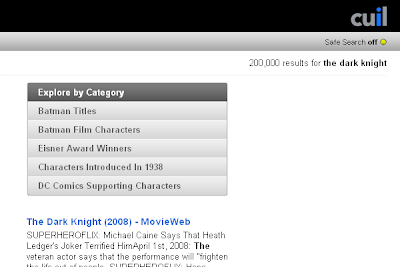
A few more searches of popular terms turned up similarly relevant results on the first page, though there were enough shady sites alongside them to make me suspicious.

Again, though, despite its claims about index size, I found Cuil's depth to be lacking. For example, my search for something at which I couldn't stop laughing that day, "horse backflip":
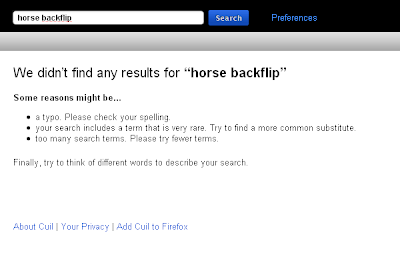
Google, for the same query, turns up over a million results, including direct links to corresponding online videos, and not just those from YouTube.

I can imagine that a decent percentage of web searches are for Warez and pr0n, and while I didn't really delve into this area, I've (ahem) heard that, there too, Cuil comes up short (har har).

Perhaps the most accurate result returned by Cuil during my testing (since fixed), is for the word "cuil" itself:

At least Cuil, the search engine, was honest enough to know that it isn't yet relevant.

Sunday, May 18, 2008

Ars Technica gets acquired

Talk about breaking news.

Sunday, December 9, 2007

Things I Didn't Know, December '07 Edition

Here are some of the things I've learned over the last couple of months:

— Phil Knight, founder of Nike, has been taking writing classes at Stanford, and is a good classmate.

— Nintendo has some excuses for its (mind-boggling, IMO) inability to meet the demand for Wii systems, as elaborated in Wired and in the WSJ.

Bill Bellamy is Shaq's cousin (link to FHM, so maybe NSFW).

— There's a documentary about CalTech basketball called Quantum Hoops.

— PCs with some Award/Unicore BIOSes will, seemingly at random, play classical music to signal problems with CPU fans and power supply voltages!

— Rudolph, the Red-Nosed Reindeer, was created as an advertising gimmick for Montgomery Ward. His creator's brother-in-law wrote the now iconic song about Rudolph, sung by Gene Auntry, for a Max Fleischer cartoon.

— Speaking of Christmas music, there are tons of cover versions of "Last Christmas", Wham's gift to the world.

— The Ten Mafia Commandments.

— An expert Scrabble player would not have set the highest Scrabble score ever, given the same circumstances in which it was achieved.

— The first three-way tie in Jeopardy history (where everyone came back) was a true act of generosity, and the guy who made it happen planned it that way.

Monday, October 29, 2007

Detailed Ars Technica review of OS X Leopard

As usual, Ars Technica has a very detailed review of the new Apple OS X Leopard that came out. In (a very brief) summary:
  • Lots of potentially good backend changes
  • System speedups all around
  • Good overall UI interface changes
  • Bad Dock
  • Stacks doesn't work as well as it should
  • WTF did they do with the old icons
  • Finder still sucks in some ways
Maybe I'll put up my impressions sooner or later about Leopard.

Thursday, October 18, 2007

ask.com-2 google-0 The Javier Bardem Story

I was having a conversation about an upcoming movie. It is called No Country For Old Men.

During conversation the actor named Javier Bardem came up. I wasn't sure who exactly he was. I went back to my desk to do a search. As touched upon very briefly in an earlier post, I'm doing a search engine bake-off between google and ask.com. For background I began using ask.com for the following reasons:

1) I saw a cool commercial for ask.com where there is no narration and the website and clicking does all the talking.

2) I'm a fan of Barry Diller (minus the Dennis Kozlowski-esque luxuries).

3) I am a (very small) share holder of IACI, so I figure I'd use one of their 238,427,530,238,492,034,234,626,234 products.

4) I definitely like to try different things as well as have the belief that certain types of competition breed better products.

I still have a knee-jerk reaction of typing in google.com when I open a web browser. This time was no exception. I figured all I'd need is an image of Javier Bardem so I did a Google image search instead of going to IMDB. Google images is billed as, "The most comprehensive image search on the web." Here is what I found:


Now I'm not saying that any software in any universe is perfect but recently as I've been performing searches with both search engines I've been getting better luck with ask.com. My bake-off is not by any means academic, but it's just my framed experiences. The thing that sucks most about the Javier Bardem search is that I did this at work. If you take a look at the first image that was returned by google, it is by no means a "SafeSearch" image. I hope that the people that monitor the web browsing at work don't think I look at questionable material. All jokes aside, lets look at what ask.com (which is not billed as the most comprehensive anything) returned:


When I first started using google a long time ago I really appreciated it's simplicity. I still do. Given that 100% of my home computers are not even "worthy of donations" as someone put it, my computer has a hard time processing a lot of busy stuff. ask.com is definitely busy compared to the likes of google. At home, something like a google is well suited to my tastes/needs. At work, one of my computers is not so old so ask.com works just fine and fast.

Although I do appreciate the simplicity of google, it is refreshing to see a website that intelligently employs useful tools such as wikipedia and news integration and also related names and other search suggestions. I don't necessarily need everything spoon fed to me, but it is cool to see that ask.com provides extra value when available and appropriate. I know that one could easily argue that an image search should have images only, but I feel like their layout has a good mix of nice-to-haves and focus on the image search. One major plus is that the images are at least suitable for work. It is funny to see that the first image that shows up on both search engines is not exactly what I was expecting. Maybe people who normally search for Javier Bardem are looking for that?

Without getting into a search engine religion argument, ask.com seems to be pulling ahead in my (poorly written) book. (Cliche high school newspaper style article ender coming up...) Now if I could just get a faster computer and stop myself from typing the G-word everytime I open a web browser...

EDIT: I just reviewed the now published post/images and realized that whether you're ask.com google.com or gramma's search engine, image searching still has a long way to go. Half the pictures returned by either search engine were way off. Unless there is a lot more to Javier's career than I'm aware of...

Sunday, October 14, 2007

The Zettabyte of Data Cometh

Source Linux Journal November 2007 Issue 163. Back issues excluding the current month are available for view online at www.linuxjournal.com. The journal each month for a long time has a regular column titled "LJ Index". It's typically a stream of about 20 statistics somehow connected...maybe.

The sources listed at the bottom include a whitepaper which is actually cited from an emc website along with a web ticker estimating total data created and replicated to date this year. See Expanding the Digital Universe. Guess I'll go read that white paper sometime.

1. Average measured speed in Mbps of a broadband connection with "up to 8 Mbps download speed: 2.7

2. Lowest measured speed in KBps of a broadband connection with "up to 8Mbps" download speed: 90

3. Number of consumers out of five who get the broadband they signed up for: 1

4. Percent of surveyed consumers out of five who have felt mislead byh providers' advertising: 30

5. Billions of Internet users in 2006: 1.1

6. Additional millions of Internet users expected by 2010: 500

7. Millions of video streams per day served by YouTube: 100

8. Number of surveillance cameras in London: 200

9. Trillions of bits sent by London surveillance cameras to their data center: 64

10. Terabytes accumulated per day by Chevron: 2

11. Total exabytes of data in 2006: 161

12. Multiple in millions of 2006 data total to all information in all books ever written: 3

13: Percentage of the digital universe that will be created by inidividuals by 2010: 70

14: Percentage of the current digital universe that is subject to compliance rules and standards: 20

15. Percentage of the current digital universe that is potentially subject to security applications: 30

16. Exabytes of "user-generated content" expected by 2010: 692

17. Total exabytes of data expected by 2010: 988

18. Percentage of the 2010 digital universe for which organizations will be responsible for security, privacy, reliability and compliance: 85

19. Exabyte capacity of media ready to store newly created and replicated data in the 2010 digital universe: 601

20. Year in which the amount of information created will surpass available storage capacity for the first time: 2007

Sources: 1,2: which.co.uk, 3,4: moneysupermarket.com, 5-20: Expanding the Digital Universe by John F. Gantz et al, a March 2007 IDC whitepaper.

oo